

The Self-Indictment of the SSPX
On the July 1 episcopal consecrations and the schism that was already there
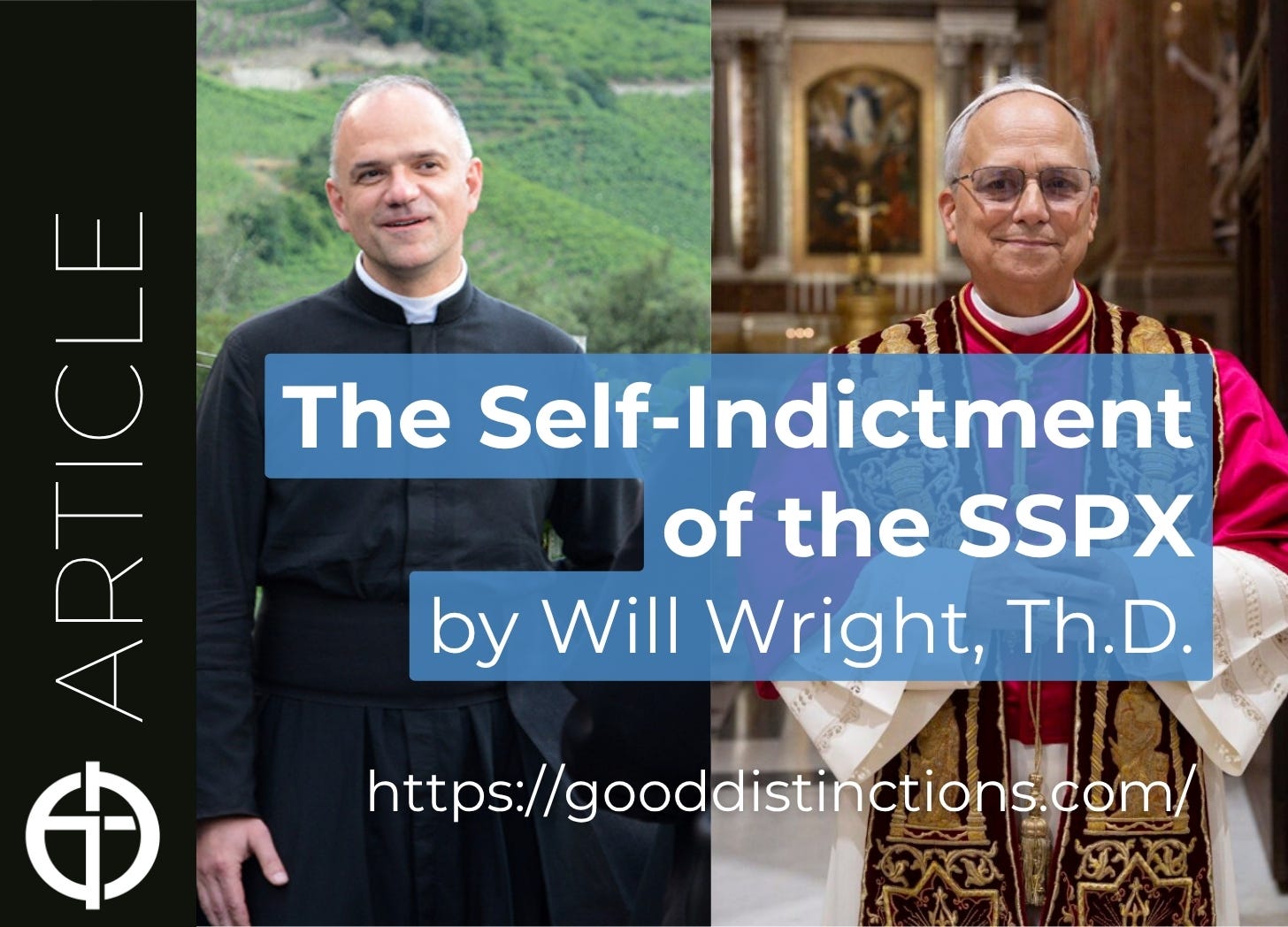
In a few short days, the Society of Saint Pius X (SSPX) plans to ordain four priests as bishops. They are doing this in direct opposition to Pope Leo XIV and the Vatican who have said that these consecrations are illicit. The Pope has warned the SSPX over the last months that the ordinations would push the society towards full schism. The Society’s refusal to accept “certain fundamental elements of the Church” would cause division, carry the penalty of excommunication, and would constitute “a schismatic act.” (Read more here).
The Society, for their part, denies that this act would constitute schism. In a letter on June 24, the Superior General of the SSPX states that the “Church suffers under the pressure of new forces” which are a genuine crisis demanding courage and action. The episcopal consecrations, in this light, are a preservation of the traditional and perennial magisterium of the Holy Catholic Church. The SSPX released a Profession of Faith which runs 154 paragraphs.
The Profession of Faith is largely orthodox and beautifully written. Having read a lot of documents produced by the SSPX, I expected more of the same. Admittedly, this document is (mostly) a work of art and a credit to the scholarship, faith, and zeal of its authors.
The current crisis in the world is summarized in par. 145:
“I acknowledge in particular that modern errors represent a dreadful threat to the whole of the Catholic order, and that their penetration into the life of the Church, under the influence of the Second Vatican Council and the post-conciliar reforms, has provoked a crisis of exceptional gravity: agnosticism attacks the knowledge of God; naturalism attacks the necessity of grace; subjectivism attacks the supernatural motive of faith; relativism attacks the immutability of dogma; situation ethics attacks the divine law; liberalism attacks the Social Kingship of Christ; false ecumenism attacks the uniqueness of the Church; collegiality and synodality attack the divine constitution of the Church in her hierarchy; liturgical anthropocentrism attacks the Holy Sacrifice of the Mass.”
I wholeheartedly agree with the diagnosis of the errors of agnosticism, naturalism, subjectivism, relativism, situation ethics, and liberalism. However, what SSPX misreads as false ecumenism, collegiality, and synodality is problematic. These terms have been twisted from their true meaning and, after this many decades, seem to be willfully misrepresented. At any rate, the mention of the Second Vatican Council, the “post-conciliar reforms” and the “liturgical anthropocentrism” which allegedly attacks the Mass is the most revealing sections of this otherwise excellent document.
Regarding the Holy Mass, the document states in paragraphs 124-126 that:
“I profess that the traditional Roman Mass, celebrated according to the rite in use before the reform of the Novus Ordo Missae, expresses with incomparable clarity the Catholic doctrine of Sacrifice, the priesthood, and the Real Presence. But I observe with sorrow that the contemporary liturgical reforms have departed considerably from the traditional liturgy, on the whole as in its details: in so doing, they have obscured the sacrificial and propitiatory character of the Mass, fostered a democratic conception of worship, brought Catholic liturgical expression closer to Protestant conceptions, and thereby contributed preponderantly to the loss of the sense of the sacred, the corruption of the Christian spirit, the decline of vocations, and the general weakening of the Faith.” (124)
“I therefore reject every liturgical reform or usage which, through omission, doctrinal ambiguity, or practical orientation, favours heresy, weakens faith, departs from the Catholic doctrine of the Mass as formulated at the Council of Trent, or turns the faithful away from the adoration due to God. The public worship of the Church must express the Catholic Faith without equivocation.” (125)
“I am certain, finally, that the Catholic restoration of peoples necessarily involves the restoration of divine worship, through the traditional liturgy of all time. Where the Mass is celebrated as the true Sacrifice of Christ, faith, piety, the life of grace, Christian families, vocations, and the desire for eternal goods are reborn.” (126)
To be sure, the Mass is not celebrated reverently or even according to the rubrics in many locales. This is a travesty which must be corrected. The democratic conception of worship and anthropocentric focus of many Catholic communities is unfortunately an accurate description. I join the SSPX in condemning such actions unequivocally. However, the deficiency in practice of some communities is not an argument against the duly promulgated Missale Romanum actively and peacefully received by the whole world for the last 56 years. Liturgical abuses exist because of human failing, but the Mass is not a poison, nor are the post-conciliar liturgical reforms a mistake.
This is not new. Archbishop Marcel Lefebvre, the Society’s founder, called the New Order of the Mass ‘a poison to the faith.’ The Profession of Faith of 2026 is more careful in its language, but paragraphs 124–126 make the same judgment. The ordinary worship of the Catholic Church is, in the Society’s operative premise, deficient, anthropocentric, quasi-Protestant, and corrosive of faith. It is the core of the real separation between the Society of St. Pius X and the Holy Catholic Church. The Society has operated outside full canonical communion since its founding, a situation the 1988 consecrations made acute and irreversible.
The irony really sets in when we arrive at par. 69 of the document, where the SSPX declares:
“I profess that the whole life of the Church depends upon [the Holy Ghost’s] action. It is He Who assists the ecclesiastical Magisterium, and especially that of the Pope, so that it may preserve, declare, and explain the revealed Deposit without error: not that it may invent new doctrines, but that it may penetrate more deeply, in the same sense and the same meaning, the truth already revealed by God to the Apostles.” (69)
The Spirit assists the Magisterium to preserve and penetrate revealed truth in order to guard the sacred Deposit of Faith. The Society professes this, but then acts as though the Magisterium catastrophically failed at its most basic function since 1969. The Profession of Faith does not support the planned consecrations on July 1st, it indicts them as a schismatic act.
Schism is a disposition before it is a decree. A community that will not commune in the Church’s ordinary worship, and that substitutes its own judgment for the Magisterium it claims to revere, has already chosen separation. The upcoming July 1 consecrations would not make schism new, but it would render it more fully visible.
Pray that the Society steps back from the edge. The Church has enough wounds.
I agree the document is very well written. And at parts is quite beautiful. But I still take a very dim view of it for three reasons.
1. It is presumptive to put out a contrary statement of faith when they have refused to accept the current Catholic statement of Faith. Most notably giving Religious submission of mind and will to non definitive Magisterial teachings. The Church is not a body of dueling creeds (as they note on their part on the fillioque.)
2. That in said statement of faith, argue many positions as definitively defined that the Magisterium has not defined or even taught the opposite of in Vatican 2. They are binding what they have no right to bind. Examples might be their bit in non Catholic religions or on Balthazarian theology. I'm not against people disagreeing or putting out statements that they disagree. Just not as a statement of faith in contrast to the Church.
3. In light of these other two points I question who is this Creed for? It's certainly not to get them in good graces with the Pope or the Bishops at large. There is more than enough inflammatory statements inside it. So then it's not in aiding in brifgeing the divide. Nor was it given with time for Rome to properly consider, read through and formulate a response to it before the proposed consecrations. No it seems by its contents and timing to be a rallying cry to the laity to join them into their schismatic actions. For that I find it repulsive.
Excellent article, relying on facts rather than emotions from a well informed and thoughtful traditional Catholic.