

Renew All Things in Christ
The Beginning of the Pontificate of Pope St. Pius X
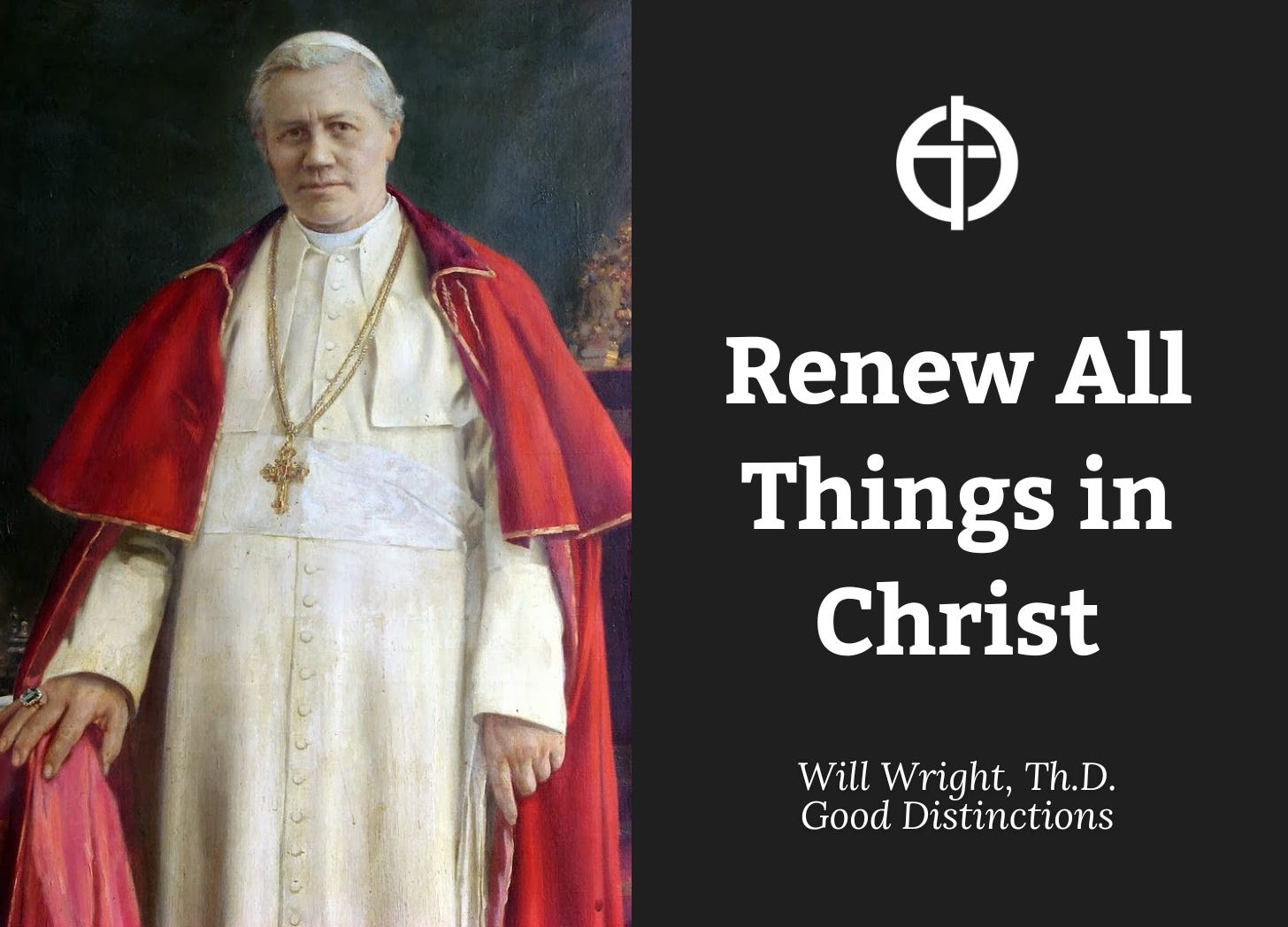
Shortly after becoming the Bishop of Rome, Pope St. Pius X issued his first written address entitled “On the Restoration of all things in Christ” (E Supremi). Unlike many modern encyclicals and exhortations written for a general audience, this is addressed first and foremost to the leaders of the Church. In many ways, this 16-paragraph document is the manifesto for his pontificate. While I highly recommend reading it in full, my desire here is to provide a basic summary of the sentiments, hopes, and calls of the Roman Pontiff. What he says is truer now than when he wrote it and we would benefit greatly from answering the call.
Renew All Things in Christ (par. 1 - 4)
The Pope begins by expressing the great sorrow he feels in assuming the highest earthly office in the Catholic Church. Drawing from St. Anselm’s address upon becoming Archbishop of Canterbury, he says that the present times are incredibly challenging and the weight of the responsibility is overwhelming. The Pope writes:
We were terrified beyond all else by the disastrous state of human society today. For who can fail to see that society is at the present time, more than in any past age, suffering from a terrible and deeprooted malady which, developing every day and eating into its inmost being, is dragging it to destruction? (3)
This might seem dramatic, especially in 1903. What is the Pope possibly talking about? He says that the malady is “apostasy from God.” Complete utter separation from the Almighty.
However, he refuses to be afraid and takes his courage in God. The program he set out for his papacy is drawn from Ephesians and Colossians: “of restoring all things in Christ” (Eph. 1:10) so that “Christ may be all and in all.” (Col. 3:2) Like any good pope or bishop, he said that he desires to eschew all partisan and earthly interests. Here he gives his papal motto which is “Instaurare omnia in Christo” or “To renew all things in Christ.”
The Contest Between God and Man (par. 4-6)
Pope St. Pius X took in the world around him and saw two main forces: the destruction of faith and the elevation of man over God. This widespread malice and “great perversity” in the world might be the arrival of the end times, he mused. Obviously, we are still here 123 years later, but the aggressive attacks on religion, dismantling of dogma, and severing of humanity’s connection to the divine remains. Humanity has arrogantly attempted to replace God, especially through the Enlightenment. They have disrespected the majesty of God and turned the universe into a temple of self-worship. These trends have not improved today.
No one thinking clearly, the Pope says, can “doubt the issue of this contest between man and the Most High. Man, abusing his liberty, can violate the right and the majesty of the Creator of the Universe; but the victory will ever be with God.” (6) Of course, the idea of triumph over God is a delusion.
Peace and Justice (par. 7)
Pope St. Pius X does not suggest that the progress of civilization is a wholly bad enterprise. In fact, he says that progress is “justly extolled.” But he sees “greater part of mankind fighting among themselves so savagely as to make it seem as though strife were universal.” The Pope then points out something timeless and darkly ironic: “The desire for peace is certainly harbored in every breast, and there is no one who does not ardently invoke it.”
He sees justice and peace as flowing from connection to God. Without God, there is no peace. Without God, there is no justice. Only with God can men hope and labor for peace, and it is by attracting men and women to association with God and with one another that they can “really be urged by the love of peace.”
The Aim of the Church (par. 8-9)
Establishing that peace and justice are universally desired and rely on connection and cooperation with God, the Pope repeats his call, his manifesto, his deepest desire: “… to restore all things in Christ and to lead men back to submission to God is one and the same aim.” (8) For those within the Church, from the Roman Pontiff down to the newly baptized baby, the way forward must only be in Christ, through obedient submission to God. But how? How can we hope to do so? The answer is simpler than most people make it out to be.
The Pope states clearly that “the way to reach Christ is not hard to find: it is the Church.” (9) Human society, now “estranged from the wisdom of Christ,” needs to be subject to Christ. Only then can evil give way to the good. The way to do this, the aim of the Church, needs to be the restoration of the “holy laws and counsels of the gospel,” the proclamation of the truths of the Church, to teach on the sanctity of marriage, to educate and discipline the youth, to teach on the proper order of possession and use of property and the duties of man and the State, and to “restore equilibrium between the different classes of society according to Christian precept and custom.” (9) In other words, Catholicism must become the guiding force for good, implicitly and explicitly, in the world on every level and in every sphere of human activity.
Formation, Instruction, and Correction (par. 10-13)
The saintly Pontiff then turns his attention to the formation of priests which he says must be the “first care” for bishops to “form Christ in those who are destined from the duty of their vocation to form Him in others …” (10) The holiness of the clergy is fundamental to the health of the Church. The Pope goes as far as to say regarding the formation of priests after Christ: “All other tasks must yield to this one.” (11) Dioceses must ensure that seminaries have equally “soundness of their teaching” and “spotlessness of their morals.” (11) As an aside, it is worth reminding each of us that we must pray for good, holy priests, but we must also defend them, support them, love them, and honor them.
One of the strongest charges of the Pope to bishops and priests is this: “Do not then pay heed to private interests of any kind, but have at heart only God and the Church and the eternal welfare of souls …” (11) How often do special interests proposed to local ordinaries and pastors take the lead over the eternal welfare of souls? When bishops and priests are well ordered, their parishes will be well ordered, and the people will be well ordered. The Church is, was, and will always be hierarchical.
People have free will, reason, and liberty. One way to address misbehavior in various arenas of human activity is religious instruction which Pope St. Pius X says will “restore the empire of God” in the souls of the faithful. (12) Knowledge cannot overcome the effects of original sin, but many evil actions can nonetheless be avoided by dispelling ignorance. The “progress of knowledge” does not extinguish faith, but, rather, ignorance is what fuels unbelief. Teaching must intensify. We must not water down doctrine. We must not shrink back from tough issues. We have to hold Catholics and those of good will to a higher standard. However, the Pope says that when correction happens it must be Christlike. That is, it must be done with tenderness and compassion.
The Laity, Too (par. 14)
In the final major paragraph of E Supremi, the Pope says that it is “all the faithful without exception, who must concern themselves with the interests of God and souls.” (14) Of course, this must be done under the direction and orders of the bishops. Yet, there is true religious commitment that requires action and not merely intellectual debate or eloquence. The faithful must observe the divine and ecclesial laws, openly profess the faith, and practice selfless charity.
Living by these “luminous examples” is more effective, by far, at overcoming doubt and drawing others to Christ than mere words. When communities begin to observe God’s laws and participate in the life of the Sacraments, society will naturally be renewed and restored in Christ. Justice is fostered, charity is increased, and mutual respect between citizens and authorities, between rich and poor, will increase.
Ultimately, a society that is rooted in the virtue of religion lived well (piety) will ensure that the Church is safeguarded from foreign influence and will practice full liberty and independence. This will inherently protect the common good and bring true, lasting peace to nations.
For Today
The document is well worth a read. Again, what is striking to me is how timeless it is. At the turn of the 20th century, the secular world was in an optimistic period. There had not been a war in Europe among the great powers since 1871. Yet, Pope St. Pius X prophetically saw where modern philosophies, unmoored from the divine, were heading. It is widely known that the outbreak of World War One broke his heart. He died weeks after the beginning of that war.
When the Church speaks, we would do well to listen, especially in a time of war, strife, unbelief, and great unease. Pope St. Pius X has so much to say to us today. I only reviewed E Supremi today. But I would highly recommend reading more of his work:
Pascendi Dominici Gregis (1907) - On the Doctrines of the Modernists
Acerbo Nimis (1905) - On Teaching Christian Doctrine
Divino Afflatu (1911) - On the Reform of the Roman Breviary
Or read all his encyclicals!
Good Distinctions will always be free. If you have received anything from this post, I would simply ask that you share it with your friends and family. Please share!